I don't think influence
has changed at all.
I think it's the way that we influence
people and the, the tools and
vehicles that we use have changed.
Welcome to Chief Influencer, the
show that explores how remarkable
leaders earn trust, influence
others, and move people to action.
I'm your host, Anthony Shop,
Co-Founder of Social Driver.
Through candid conversations and live
events, we are on a quest to find
incredible leaders in unexpected places.
From Oscar-winning storytellers and
ambassadors to US senators, founders,
and movement builders, we share the
stories of these chief influencers to
uncover lessons that you can apply to
your own work and leadership, because
sometimes the breakthrough you need
comes from someone facing a similar
challenge in a completely different field.
Hey, it's Anthony.
This Thanksgiving week, we're
revisiting our conversation with
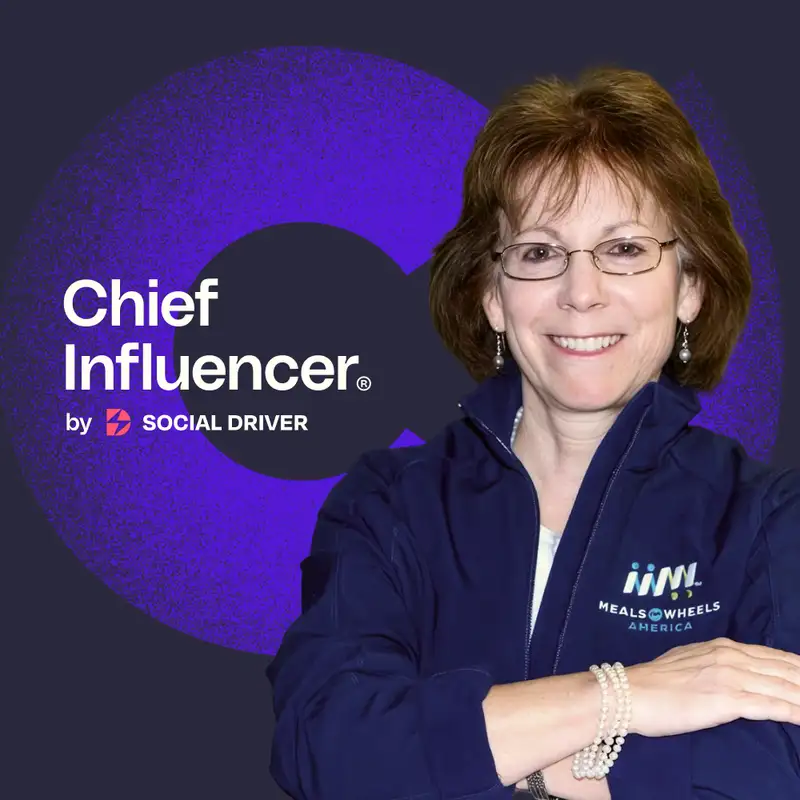
Ellie Hollander, president and
CEO of Meals on Wheels America.
Their mission is actually really personal
to me because I remember seeing the
difference Meals on Wheels made for
my great-grandmother when I was a kid.
It's always been about
more than just a meal.
It's also about human connection
and looking out for our neighbors.
And there's incredible news to celebrate.
Since we recorded this conversation,
philanthropist Mackenzie Scott
made an extraordinary $70 million
gift to Meals on Wheels America.
The organization quickly distributed
a significant amount to local
providers while also planning longer
term investments to help strengthen
the network for the future, and the
timing couldn't have been better.
To me, it's, I think, a remarkable
vote of confidence in Ellie's
leadership and this vital mission.
And, uh, you'll hear a little bit
about her, and I think you'll agree
that this was a smart investment.
But the need remains urgent, with many
older adults still waiting for services.
So a huge congratulations to Ellie
and the Meals on Wheels team.
And this Thanksgiving, if you'd
like to volunteer or donate,
visit mealsonwheelsamerica.org.
Now here's our conversation
with Ellie Hollander.
I hope you enjoy it
Well, I am thrilled to welcome today's
guest, Ellie Hollander, president and CEO
of Meals on Wheels America, the National
Leadership Organization supporting more
than 5,000 community-based programs,
delivering nutritious meals, friendly
visits, safety checks, and essential
services to older adults across the us.
Their mission is to improve the
health, independence and quality,
uh, life of seniors, ensuring no
one is left, hungry or isolated.
Before we jump in, I just
wanna share a personal note.
I first learned about Meals on
Wheels at an early age, visiting my
great-grandmother in Kansas City.
I remember a kind man arriving at the door
with her lunch and I said, who's this?
And my family said, well,
he's from Meals on Wheels.
And at the time I didn't grasp the
full significance, but I've come to
appreciate just how meaningful that moment
of care and nourishment and dignity.
Truly was.
So I'm especially excited
to speak with Ellie today.
And before we dive in, there
are three things I wanna
make sure You know about her.
Number one, she's a champion for aging.
With dignity, leading the charge to
eliminate wait lists for services
across the country, through the bold
and the weight initiative, and helping
millions of older adults remain
healthy and independent at home.
Number two, Ellie brings
a unique perspective as a
former Chief people officer.
Uh, she was in that role at A A RP
and she developed a people first
leadership philosophy that now
shapes her approach to team culture,
partnership and purpose-driven strategy.
And I'm excited to talk about
influence on the inside today.
Lastly, she's fostered a nationally
recognized workplace culture at
Meals on Wheels America earning
Back to Back Honors and the Best
Culture Awards by kudos for culture,
innovation and culture leadership.
Ellie, you have been called Many Things,
a Forbes 50 over 50 honoree, silver Stevie
Award winner, Washington Business Journal,
woman Who Means Business and A Results
for American nonprofit All Star Today,
we're happy to add to that list and we're
proud to call you a chief influencer.
Welcome.
Thank you, Anthony.
Delighted to be here.
I'm really, uh, excited to
have this conversation today.
You know, you stepped into your role at
Meals on Wheels America at a moment when
the need was, was great and was growing.
What did You know about Meals on Wheels
before becoming CEO and what motivated
you to say yes to leading this mission?
Well, first of all, I think I knew
a little bit about Meals on Wheels
because it's such a well known brand.
I mean, everybody's
heard of Meals on Wheels.
Nine out of 10 voting adults in
America know of Meals on Wheels.
And those that know us think favorably.
So I imagine, I think what Alon
of people do is it's about meals.
and we'll, we'll talk about
dispelling that, that it's so
much more than just a meal.
But at the time, I didn't appreciate.
That it was more than nutrition
at the door or in a senior center.
Um, and as you said, when I was asked or
invited to take this role, the need was
great and growing, but honestly, has grown
even more rapidly today than it was then.
it was actually a behind
closed doors issue.
I used to talk about the double
epidemic, silent epidemic of senior
hunger and social isolation because.
Really mo most of us aren't aware of
it unless we're involved in Meals on
Wheels or three degrees of, of separation
like you with your great-grandmother.
um, what motivated me, I think,
let me step back just for a second
and say, You know, who wouldn't
wanna work for an organization
with a brand like Meals on Wheels?
Um, and who wouldn't wanna make a
difference in the lives of millions
of seniors across the country?
But I think to take on a leadership
role like that, particularly
at that time in my life.
You have to be willing to give 150%.
And I was dealing with some issues,
some health issues in my family.
My sister, older sister had just been
diagnosed with advanced breast cancer.
My father, who was in his early
nineties, we had just moved into,
uh, an independent living facility
and I was the only one of my three
other siblings that lived in the area.
So I know, I knew I needed to be
available to him as a caregiver.
And I also wanted to spend quality of
time with my sister as much as I could.
So the opportunity to take on a role
like being a president and CEO of
an organization like Meals on Wheels
America, the timing wasn't perfect for me.
So I was a little reticent about it.
And, um, I, You know, prepared for
my first interview with the board
nominating committee kind of hesitant.
I mean, believe it or not, not because
I didn't wanna do it, but the question
was, did I have the, the emotional.
Fortitude at that particular
Yeah.
I wanted to spend time
with my, with my family.
So after I interviewed, uh, with the
nominating committee, I absolutely
fell in love with these leaders of
local Meals on Wheels programs who
are so passionate And so engaging.
And I thought, my goodness, if I
don't do this now, I will regret it.
And I did speak to my dad at the time,
my 92-year-old father, and at the time,
You know, my sister and I said, look.
I am torn about this and 'cause our
family is very close and we talk
about things like that and, and both
of them said, you have to do this.
And so that motivated me, kinda gave
me permission, Anthony, if you will,
to say, okay, I'm gonna go for this.
And then my second interview, I went with
Augusta and I'm like, I want this job.
And I'm so, so glad that I.
That's amazing.
I love that story.
I think it says Alon that you were, uh.
Really intentional about, You
know, is this the right time?
Is this the right moment?
Is am I ready for this?
And that, that enthusiasm from the
nominating committee and meeting
some of the leaders, kind of plus
your, your endorsement from your
family pushed you over the edge.
So that's pretty cool.
It occurs to me that the timing right
now for Meals on Wheels is interesting.
You talk about the need
being, You know, so great.
Um, the.
The number of Americans who
are senior citizens is growing.
So just the, the population
pool that you serve is growing.
And we know, obviously there have
been reductions in government
funding for all kinds of things.
And so that's sort of a
another counter factor.
Many people may not realize that
today there are seniors waiting
for Meals on Wheels services.
You know, they're signed up,
but they're on a waiting list.
Um, why is that the case?
And can you talk about the.
End the weight initiative that you
launched to change that reality.
Right.
So yeah, let's step back just for a
moment and say that basically Meals on
Wheels providers, um, in communities
large and small, rural, suburban, urban.
Have been providing this important
service, which I mentioned is nutritious
meal, but also moments of social
connection, safety and wellness checks
in the home, but also in senior centers.
Um, really, uh, as the first and sometimes
the first line of communication with
an older adult and able to connect them
with other services that they may need.
Um, network of providers has been out
on an annual basis to over 2 million
seniors annually, which sounds like Alon.
But as the population has grown, the need
has grown exponentially and there are
probably at least 2.5 million additional
seniors out there who could benefit from
Meals on Wheels and aren't getting it.
So we did, and we constantly do
sort of pulse surveys of our Meals
on Wheels providers to find out
what's the wait list look like.
Now, these are people, Anthony,
that actually know about the Meals
on Wheels service have reached out.
Yeah.
And are, You know, are told,
look, we don't have the resources.
And I'll get to that in a second.
Why are the waiting lists where they are?
But we did the most recent survey we did,
we found out that one out of three Meals
on Wheels providers have have a wait list.
And of those folks on the wait list,
it ranges from anywhere from, You know,
one month to four months on average.
Four months a person is on a waiting list.
And some of these programs have waiting
lists as large as 2000 people, is just.
Mind blowing if you think about it.
And why is that?
Because the resources have never
kept pace with the growth in
the population or inflation.
Simple as that.
And um, many people may not realize
that Meals on Wheels is a, what we
call a public private partnership.
The federal government through the Older
Americans Act largely provides, you will,
what I consider foundational funding.
And that probably represents
about one third of the funding.
And the rest providers are expected
to be able to find matching funds,
whether that's through their local
communities, through individuals,
corporations, foundations, and even
through contributions of those seniors
themselves, who obviously want to pay it
forward and want to be able to contribute.
Um, to their meal.
So one of the issues that we've had is
that, You know, appropriations for the
Older Americans Act has never kept pace,
as I mentioned, and the funding just
continues to either be flat or, or a
decrease in flat in this environment given
inflation around the wheels and the meals.
I mean, the fuel that our programs are
dependent on, the, the vehicles, the food.
The distribution, the volunteer or
the paid salary network of, of the
staff that work for meals and wheels
that continues to grow unabated.
And so basically flat funding is a cut.
And year over year we've seen,
we've seen more and more reductions.
So that's what's happening.
And.
know I'm spending Alon of time on
this, but end the way 'cause you
asked Alon of questions in there
Yeah.
are, is is really our, our bold
national campaign to inspire
and to influence action.
To create a movement where people
understand what the dire need is in our
country, why it matters from a social
and an economic standpoint, and provide
ways for us to ensure that any senior
who needs Meals on wheels, including
those on a waiting list, can get it.
So that it's there for the long term,
that it's not only being sustained,
but it is growing to meet the need.
when we think of influence,
words are so important.
Branding, messaging, meals on
Wheels is such a strong brand.
You mentioned nine out of 10 voters
are familiar with it, have a positive
impression generally, and it, it rhymes.
It's memorable, it says.
The core of what you do, right?
Because it helps to communicate the,
You know, that you deliver meals.
Uh, but as you sort of mentioned earlier,
Alon of people may not realize how much
more these programs provide beyond food.
And I wonder if you could
share a little bit about.
How you describe that full impact to
someone who may only think of meals
and, and maybe I'd love to hear your
take on just, is it, You know, kind
of the double-edged sword of having
a great memorable brand that does
clearly communicate the what you do, but
that maybe sometimes it makes it, um.
You know, uh, well, a challenge or an
opportunity for you to say more about
the why, because it's hard to, You
know, package that in, in, in your name.
So I'd love to hear just a little bit
about the message you use and how do
you get those, the, what words do you
use so that somebody quickly understands
that you're more than just the meal?
Yeah, well, it, it, it is a
double-edged sword in a way, but
I still would rather start with
a brand as well known as Meals on
Yeah.
go from there.
So let's say that I think the
biggest challenge, uh, is what's
gonna resonate with somebody.
So when I describe Meals on Wheels,
um, You know, do I talk about the
fact that it enables independence
and it enables a senior to live?
Longer in their own homes, more safely,
independently, uh, more health healthfully
than they possibly could otherwise.
Um, I talk about that.
I talk about what it enables.
And I talk about the different
kinds of services that we offer.
I mean, for people that love pets and
who doesn't love, uh, uh, their pet.
Uh, probably one third of Meals on
Wheels recipients, um, have loving
furry companions and they want to be
able to stay with their companion.
We don't want them to give
their meal to their pet.
So we work very closely with
other corporate sponsors
like PetSmart Charities.
Um, to be able to augment what we do
with the meal for a senior to also
be providing services and supports
to keep the, those loving companions
with their seniors together.
'cause that that addresses
social isolation.
So that's the other thing, a
nutritious meal, social isolation.
What we wanna do is
create those connections.
We also work with other providers
like the Home Depot Foundation
because when we go into senior's
homes, sometimes it's not safe.
They're tripping hazards
where their homes, uh, may be.
Uh, having a leak in the, in
the roof or their steps just
to go up are, are dangerous.
So we, we work with other organizations,
corporate f foundations like the
Home Depot Foundation to shore up
and create, um, You know, more safe
homes so people can live longer.
So I talk about independence, I talk about
health and, and wellbeing and safety.
But I also talk about the more than
a meal, which is the nutritious meal,
if you will, is the entree that opens
the door if we're delivering a meal
to a home down senior, but we also
do have senior centers that we run.
Um, we talk about the fact that it's
maybe the only time someone is gonna see
a person in a given day or even a given
week, depending on where they're living.
Uh, we talk about the fact that it's
the eyes and the ears in the home.
So that we're able to see if someone
does not seem well, if they're taking
a long time to come to the door or
if they don't even answer the door.
oftentimes we are the person that's
contacting a family member to say,
You know, Hey, we went to see Anthony,
but he didn't answer the door.
And he is always there, he's
always waiting for us to arrive.
We're concerned.
So these are all the things that, that
we do that we don't even think about.
Um, and I, I, I'll share a story with you.
I'm sure you're gonna ask me
for a memorable story that
kind of, I think, exemplifies.
That it is more than just a meal.
And we, one example is we, You know,
we're very dependent on volunteers
to keep our wheels rolling.
We have paid staff, but we couldn't
do what we do if we didn't have
volunteers to help support what we do.
So this particular volunteer,
her name is Debbie.
had been volunteering for a
long time, uh, to one of her
clients was someone named Dennis.
And Dennis was deaf.
Um, and Dennis was able
to read Debbie's lips.
Hmm.
So that she was able to create that
connection, that that relationship that
so many volunteers talk about, uh, that
they, they, they create long lasting
friendships, but when the pandemic hit
and people were masked, and Debbie was
masked, Dennis couldn't read her lips.
And this, this was very concerning to her
because she knew that she was probably the
only person that was visiting Dennis on
a regular basis and checking in on him.
she turned to, um, learn American Sign
Language by googling it and getting on
and doing YouTube, and learning how to
do American Sign Language so that she
could continue to communicate with Dennis.
they stayed in close touch.
She still is volunteering.
Um, and he became her teacher
and, and helped her learn.
I mean, this is just one of scores
of stories that I hear about, You
know, every single day in terms of it
isn't just about the meal, it's about
that relationship and knowing that
you're gonna see someone who really,
truly cares about you in a given day.
Oh wow.
What a cool story.
I love that.
And as you talked about, the different,
You know, starting with, well, what.
Does someone else care about so that
you can pick one of the other benefits
of Meals on Wheels to focus on.
If you hear Meals on Wheels, you
might think, well, what do they have
in common with an animal lover or
somebody who really cares about pets?
I wouldn't have thought about that.
But then when you describe that,
a third of, uh, recipients of
Meals on Wheels roughly have.
A pet and this independence allows 'em
to stay in their home with their pet.
Well, you can see how an animal lover
would really, really care about Meals on
Wheels because it keeps probably Alon of
pets from going to shelters, for example.
Exactly.
so I think that's such a good, You know,
reminder to us that we can find those.
Areas of interest to influence
others that You know, may not be the
natural first thing that we think of.
And then also find those, those partners,
like your support from the Home Depot
Foundation so that You know you can, um.
Help facilitate, uh, You know, repairs.
So somebody, uh, doesn't have a tripping
hazard in their home, for example.
Maybe they, You know, make a doorway
more accessible or at a ramp or
something like that, I'm assuming.
Yes.
so I think those are just some
really good reminders to us when we
think about the power of influence
and that that positioning can
make a really big difference.
I wanna go, uh, to another question
that, You know, kind of might be.
A way for people to learn something
that they didn't already know about.
Meals on Wheels, you're a federated model.
So as the leader of a federated model with
local providers all across the country.
How do you think about influence
when you are in that role?
And, You know, you can't, um, command
and control is not exactly the
leadership model that someone like
you can use or, or probably wants
to use from what we've talked about.
Uh, but it's not even possible
because of the federated model.
So how do you play that role
as influencer of your network?
well definitely not into
command and control.
That's as, as you suspected.
It's just not my style.
But I think it's understanding the
strengths of, of both organizations,
what does Meals on Wheels America do?
What can we do to make life easier for
Meals on Wheels providers in communities,
in local communities, so they can
focus on what they do best and we can.
them.
We can be their voice on Capitol
Hill or with corporate partners
to, to make the case, to influence
others to provide more resources.
Because as I mentioned earlier,
with more resources, we can scale
to meet a need that's not being met.
And it matters because it costs
our country billions of dollars
annually by not doing that.
Um.
Understanding, but in understanding what
individual providers are grappling with,
what they're dealing with on the ground
on a day-to-day basis is so important.
So listening is critically important.
Amplifying their voices, making sure that
we can aggregate the power not only of
their voices, but their buying power.
By the way, um, somebody told me
that if we were to aggregate the
chicken purchases of Meals on
Wheels providers across the country.
It.
It's equivalent to like
a Wendy's, what a Wendy's
would buy in terms of chicken.
So how do we look at the aggregate
power and the individual power, their
voices, and how do we take that and
use that to leverage directing more
resources to where they need to go,
which is in the local communities.
So I think it's important you have
to build trust like you do with
any relationship you're working on.
You have to do what you say.
You have to listen, you have to.
Remember, it's really important
to remember what you heard and
not abuse what you've heard, but
use it to really benefit all.
I always talk about lifting all boats,
making sure that what we're doing
is benefiting the network at large.
You know, this is something interesting
because I'm sure other associations.
Deal with some of the same challenges, but
our board of directors, I feel like that's
one of the roles that they play because
we have, uh, a number of local providers
that serve on Meals and Wheels, America's
board of Directors, and oftentimes they
have to take their individual program hat
off to say, You know, this may not be in
the best interest of my program to support
this, but I see that it's going to make
a huge difference for Meals on Wheels.
Writ large, and I really appreciate that.
That's really something that's difficult
to do, but I would imagine some of your
listeners do run associations and they
Yeah.
deal with this.
So I, I think that there are some
similarities here that, that we could all
think about and learn from each other.
Hmm.
That's great.
And You know, the perspective you bring,
I suspect is, uh, uniquely informed by
the fact that you served as a chief.
People, officer I, You know,
there's, I don't know, Alon of CEOs
that came up in that way and have
ever been a chief people officer.
maybe it's a perspective that, that
Alon of leaders could benefit from
today, having had to manage the,
You know, internal talent and human
resources and stakeholders there.
I wonder if you could
share how that background.
Shaped, uh, your own leadership approach,
how maybe your approach to leadership
even evolved having those experiences.
And obviously it's been successful,
it's helped foster an award-winning
workplace culture at Meals on Wheels
America, so I'd love to unlock
some secrets from that background.
Sure.
Well, it was a terrific job and I have
to say I love doing it and I didn't grow
up in hr. I grew up on the business side.
Um, so when I had the opportunity to be
a Chief people officer, um, I thought,
is this just hr? And no offense to my
HR colleagues, I felt like it needed to
be larger and, and the vision for the
then CEO at a RP Bill Novelli at the
time was just that to, to really look
at how do we nurture a culture at A ERP
that optimizes our, our asset, our most
important asset, which is our people.
Um, and I had actually prior, I think
it's important to say that prior
to that I had been in membership.
Most of my jobs had been focused on
membership, membership value getting,
uh, organizations or individuals
to renew membership over the years.
And so it was interesting for me.
To sort of switch my focus from
an external to an internal,
but always people centric.
I mean, even when I was in charge
of membership, it was about building
relationships with individuals who
then could influence whether or not
they stayed in as an organization.
So it's really Alon of the same, I'd say
the same characteristics that I had to
hone when I was in membership to bring
in to be a chief people officer, however.
I loved it because it really was ability
for everybody in the organization to
drive the organization's performance.
And at the time there it was, people were
just starting to make the link between.
engaged workforce and
organizational performance.
It was just at the very, very
beginning and Bill and I saw
that connection very clearly.
Um, and did Alon of work to really bolster
managers who had never had training.
To, to create a strong people management
core, to actually create a, an
organizational dashboard where people and
engagement was one of the measures that
we used for our organizational success.
We also, uh, at, at, when I was at A A
RP, we were focused on a best employer
for, for the 50 plus population.
We had to walk the talk and we
literally were not walking the talk
because we did a survey of our own.
Organization.
'cause we used to hold other organizations
to a certain standard and we, we
weren't meeting the standard ourselves.
And so of it was really looking at what
we needed to do to shore up, um, to get
people to be, have a line of sight with
the direction that A A RP was trying
to go to reward them and recognize
them for that, to have them feel vested
in the success of the organization.
And so we created this people strategy
where we had folks from all sides of
the business sitting around the table.
Making decisions, making sure
that our values aligned with, with
everything that we were walking
the talk as an organization.
Um, and we won Alon of
awards because of that.
And so that learning and, and feeling like
I could unleash the power of individuals
to, to create an internal movement, to
inspire people, to drive engagement,
really, I think made a huge difference
in how, You know, how I came to be
a leader at Meals on Wheels America?
This episode is brought to you by
the George Washington University
College of Professional Studies,
an accelerator for transformation.
Through flexible graduate degrees and
certificate programs, CPS prepares
today's professionals to lead in
various disciplines, including
strategic communications, public
affairs, advocacy, and politics.
Take the first step.
Visit cps.gwu.edu today.
Let's talk a little bit
about employee engagement.
So right now, um, I see some CEOs
really pushing for a return to work.
You know, I think like Jamie Diamond at
JP Morgan is an example of, of a leader
that's sort of in that camp and then.
We talked to other companies, uh,
one of our upcoming guests is the CEO
of Zapier, and they've been a fully
remote workplace since they started,
And so they're big champions of that.
Where do you fall as a CEO on remote work?
Hybrid work, You know, flexibility
and trust and You know,
proper boundaries around that.
Love to hear your perspective,
especially because you have that
chief people officer background.
Yeah.
Well, I think I have a unique
perspective because even when I was chief
people officer, I was trying to get.
is more comfortable with managing
a virtual workforce then as a, as
an employer of generally slightly
older employees, at the time, I
recognized that some of us, and
including myself, I was a caregiver.
I also was a parent of a very young child.
what was gonna work for me wasn't gonna
work for my other colleague, is that, You
know, when I work best, might have been
in the evenings or early in the morning.
Um, so that to have a workplace
that, that was one size fits all for
everybody, just didn't seem to work.
So it, I was working on change
management ago to try to get
people to embrace flexible work.
Even then, I think the philosophy
of Back to Work, I'm gonna say in
quotes, um, people are, were working.
I mean, so it wasn't like you're,
you're working from home looking
during the pandemic, we had people.
It, particularly at our organization who
were working around the clock, were giving
much more hours than they would've been
if they were spending time in traffic or
on the metro with a broken down metro.
You know, I just felt like wanted
to meet my staff where they were,
and I wanted to treat them as adults
that we are not doing direct service
at Meals and Wheels America, our
programs are, but what we needed to
do was be spending all of our time.
Absolutely focused on driving more
resources to local communities.
That's what we needed to be doing,
and if people could do that better
from home, be doing it from home.
I think the one most important
thing that I've been very aware of
new employees and younger employees
who need to be mentored and need to
feel that connection and understand.
The strategic direction of the
organization to get excited about it.
So you have to find other ways to do
that if you're not all in the office
at the same time, I resisted, um,
requiring people to be in a certain
days or a certain number of days.
I believe that people, I, I err
on the side of trusting people.
I think if you're clear on
expectations, on results, on
quality, on delivering on time.
called accountability.
You have to hold people accountable.
I'm not one to tolerate poor
performance, so you have to be clear on
expectations, but I also think that I
want people to give a hundred percent.
I want them to be able to bring their
full selves to work every day, and
to do that, I have to understand
that not everybody is in the same
life situation as somebody else.
So I want to give people the
flexibility to show us what they can do.
Uh, what I'm hearing from you,
I think, is that, You know,
to provide more flexibility.
There might be a, um, requirement
for leaders to think more about
accountability and be be clear
about what that looks like.
Are there any examples that come to mind
for you, just for other leaders who might
be grappling with this challenge between
sort of flexibility and accountability
and, You know, their instinct to
have people at their desk, but their
team's desire to have more flexibility
and maybe work from home more often.
Yeah, I mean, let me say a couple
of things and I, I hope it's helpful
to some is that when the pandemic
started, I mine was mainly concerned
about staying connected to people.
So we did weekly.
Um, You know, we had never even used
teams, You know, or before the pandemic
or Zoom or whatever it is that you use.
But we began to use those excessively,
um, weekly, getting all of our
staff together and saying, You know.
keep your cameras on 'cause we wanna
see you, we wanna connect with you,
we wanna tell you what's going on
and we wanna see how you're doing.
And I personally, Anthony, continued
to meet one-on-one with every staff
member at least once a quarter.
And I also made myself accessible as a
leader, uh, because I felt it was really
important for them to hear from me.
Uh, and also I said earlier, I think
it's important to walk the talk is that I
was, I don't ask somebody to do something
that I myself am not willing to do.
And, and I wanted to make
that personal connection.
So new employees that we were hiring
who weren't coming in the office because
the office was closed for like four
years, um, wanted the first week that
they were on the job to talk to them.
Alon of it is really about what's
going on in their personal lives.
And I've continued to, to do
those check-ins with people.
I let them decide now because I
didn't, You know, somebody might
say, well, if the CEO is scheduling
these quarterly meetings, I have
no choice but I have to do it.
And then I started to worry about that.
I didn't want people to feel
like it was punitive, You know,
if they didn't wanna do it.
So what I do is my first meeting
when they, when they first start is
their, their first or second week,
and then my executive assistant,
he asks them, how often would
you like to check in with Ellie?
She's offering to do it once a quarter.
Twice a year or once a year.
And, but you can do it, you can
change at any point in time.
So I continue to do that.
The other thing that I, silly things that
I do, uh, maybe this is not along the
lines of, uh, flexible work or not, but,
You know, I recognize people's birthdays.
I, I call people and I, I
serenaded them on their birthday.
They may hate it, but I get Alon
of positive feedback from that.
My voice isn't that great.
But I just want people to know
that I'm thinking about them and
when I meet with them one-on-one,
it's usually not about work.
It's like, what's going on in your life?
What's going on for you?
And I think because of those
conversations, I've come to understand
the variety and the diversity
of of life experiences that our
staff are bringing to the table.
And some people may also be in
a caregiving situation that we
wouldn't necessarily know about if
we were just talking about work.
So I get back to wanting to create
an environment where it's flexible
enough to meet the needs of people.
But yes, you have to be
clear on expectations.
And I also leave it up to individual
departments and, and my executive
team leaders to say, if you, we, we do
have all staff retreats where it is.
Required that people be there.
We, we, it's not like we don't
have those connecting tissue
events, um, but I do leave it up.
I do empower.
I think empowerment is one of our,
our values that I think it's important
to empower people to make those
kinds of decisions for themselves.
That's great.
Yeah.
And you, you talk about that, um.
Accessibility.
It reminds me, we interviewed Steve
Taylor, the CEO of the Arthritis
Foundation, and he said when he became
CEO, kind of two things he did right
away he moved his physical office in
the building to be more central and
left the door open because he wanted to
really show people he was accessible,
but also he has people who don't work in
that office or who aren't in every day.
So he started spending
more time on LinkedIn.
Liking and commenting on his employees
posts to show them that he was
paying attention and You know, kind
of, and he said just kinda like his
digital water cooler, he was able
to use that to scale his connections
with a number of people that, You
know, you just can't do in person.
So I love hearing the different
approaches and tactics that
leaders use to, um, keep those.
Those touch points in a world
where, You know, they don't
look exactly like they used to.
Because even if it's a, even if you are in
the same office, you might not be in the
same office as many days a week, so there
just aren't as many moments for that, You
know, kitchen, water cooler conversation.
So true.
I wanna talk a little bit about.
Kind of, uh, messaging and communication.
So, You know, you have to communicate
with Alon of different audiences,
lawmakers and donors and local leaders.
And I wonder if you could share how
you tailor your message of Meals,
on Wheels America, um, with audience
groups like that, especially maybe
lawmakers, um, because I know that,
You know, we live in a time that's
somewhat polarized and sometimes having.
One clear, consistent message.
Um, you can't use the exact same
words and the same message with
everybody, so I'd just love to
hear kind of how you approach that.
Yeah.
I think I approach regardless
of the stakeholder or, or the,
the person I'm meeting with.
I have to do my homework.
I really need to sort of
understand their background.
I watch videos if I can to, to
see, You know, what, what they get
passionate about, where they're
from, have they delivered meals, You
know, depending on what the message
is that I'm trying to get across.
Um, because, You know, you
only have seconds oftentimes to
make that personal connection.
So the first thing is you
want somebody to like you.
So I think coming across authentically
and, and genuinely interested, I in fact.
I have, uh, something on my desk that
I've, I've carried with me through
many jobs that says, be here now.
Um, so be really focused
on the conversation.
Listen, try to make that connection.
I found that, You know, depending on
with whom I'm speaking, what's gonna
resonate, what's the message that I
think has the best chance of resonating?
Um, I, I can give you an example of.
ago when I was looking for
additional, I, I'm always looking
for additional funding streams.
Let me just say that.
So any listener has any
suggestions, I'm all ears.
Um, at the time there was something called
a social impact bond where, um, if you,
if you had an intervention, which we do
at Meals on Wheels, it's evidence-based.
It shows that it's actually making
a difference if it's helping people
be more healthy or helping to save
lives or helping to save dollars.
Um, social impact Bond was an opportunity.
But if I was talking to, uh, a Democrat,
I would talk about the social value, the
social impact of Meals on Wheels, right?
Um, but I also know that if I'm speaking
to, uh, a Republican colleague, I
need to focus on, uh, the economics.
What's the return on investment?
Where are the savings?
Why should I make an investment here?
And that's the flip of a social
impact bond is called pay for success.
You only pay if you're gonna
deliver you, you, you get the
reward, you share in the savings.
And so able to pivot between two different
messages, but the kind of are around
the same thing, is really important to
learn how to do so that you're making
sure that your message is resonating.
With the person with whom you're speaking.
And I got really good at that to
say, You know, what's the motivator?
And I could even, sometimes
I may not know the answer.
So I could say, what's
more important to you?
You know, the moral imperative, or
that you're making a difference.
You're saving our country money,
you're saving taxpayer dollars.
What, what is gonna motivate you the most?
I can ask that question.
It's, and then say, okay, well let
me give you the reasons why this.
Meals on Wheels is gonna make a difference
in this way for you, for your, for
your constituents, for your local
communities, whatever the case may be.
So that's how I do it.
Oh, I love that example because You
know, at the high level, the North
star, that that doesn't change, right?
What you're trying to chi impact,
impact you're trying to achieve.
But then when you give the example of
the specific, You know, individual or
persona that you're speaking to, You
know, there are certain things that
resonate with them in certain language.
We sometimes use in our sort of our
pillars of what makes a chief influencer,
chief influencers learn the lingo.
You know, we often say that means.
You have to learn the vocabulary,
the acronyms, the way that people
in your space talk for credibility.
And it also means that if you're
showing up on online, for example,
you have to learn the lingo,
You know, of those platforms.
So somebody who's posting on LinkedIn,
they learn the best practices of LinkedIn.
I think you gave a really great
example of learning that lingo and
also being able to personalize that
messaging and language, uh, with pay
for success versus social impact.
Bonds.
So that's such a, a great nugget
to be able to, to take away.
And I'd invite folks to think about,
uh, what's that in their world?
You
Yeah.
can they make sure that they're using
language that is centered around
what their stakeholder or, You know,
the recipient of the information
cares about, and not only focus on
the way they wanna talk about it.
I think that that's,
that's really important.
Yeah.
Now, that's an example when
you might go have a meeting.
In one case.
Um, right now I know that it's a,
it's a, You know, pretty urgent
time for aging services in America.
And when you think about your
champions across the Meals on Wheels
America Network, um, how do you
rally people who are on your side?
You know, so many people believe in
Meals on Wheels, to, to stand up, to
advocate for, to champion the important
work of Meals on Wheels right now.
Yeah.
What It's all about influence.
It's, about pulling at people's
heartstrings, giving them the
stories, backed up with the
data to say why it matters.
It's the same thing.
It's that you're trying to engender
and inspire action of others.
Uh, you have to understand what is
gonna make a difference to someone.
is it a story, a compelling story?
is it the data?
It's probably all of the above.
And making it easy to, You
know, here's some talking
points, here's some statistics.
Um, You know, if you don't back
up things with real life, you're
gonna lose credibility, right?
So you have to be credible,
you have to have integrity.
Um.
And you have to, You know, to
create a movement, you've got to
galvanize people along a continuum.
I mean, it starts with generating interest
and then inspiring action, and then
continuing to steward those relationships
so that basically you're creating, You
know, an army of supporters that you're
not the person that has to be the voice.
You're enabling them to do that.
You're empowering others
to do that, and it's.
constant nurture.
You know, you can't, you can't,
it's not a once and done.
You have to continue to, uh, to
inspire others to wanna carry the flag.
And that's, what we do every day.
What's the message that you most want the
public and decision makers to hear right
now when it comes to Meals on Wheels?
Well, I mean, it is pretty easy.
I think it's to say, look, um, we all
need to care about aging in America.
We're all aging we're talking about real
people, whether it's our grandparents,
our parents, ourselves, our school
teachers, You know, people that are aging.
This is such a simple
solution that is proven.
It's been around for over 50 years.
It is a solution to senior
hunger and isolation, and all it
requires is a small investment.
The, the, the fact that I use, which
is always flooring to people, they're
like, wow, that's, that's memorable.
I can get around that is we can provide a
nutritious meal, a visit, and safety check
to an older adult for an entire year.
For the equivalent cost of roughly
that senior being in the hospital
for one day or a nursing home for 12.
And You know, we can either invest in
a proven solution today that's gonna
save billions of dollars annually.
we can cost taxpayers Alon more
dollars by en not enabling people to
stay at home where they wanna be, and
they're gonna end up in a hospital
or a nursing home prematurely.
And so that's the the point.
And I'd say every individual who may be
listening to this or in their, the sphere
of influence of people who are listening
to today, you can make a difference.
You can volunteer, you can
advocate, you can donate whether
you're, you are representing a
company, a foundation, or yourself.
Every individual has the ability to change
the narrative in our country and to make
sure that seniors who need Meals on wheels
aren't on a waiting list, and when they
need that service, when we need that
service, Anthony, it's there for us too.
That's so powerful.
I wanna ask you one final question.
Chief influencers all about influence.
Of course.
How do you define influence today
and how has that evolved over the
course of your leadership journey?
Ellie.
I don't think it's, I don't think
influence has changed at all.
I think it's the way that we influence
people and the, the tools and
vehicles that we use have changed.
I mean, you, You know, you are
a, an innovative person who
started social driver, You know
about the value of technology.
Um, and I think many of us are still
like learning how to leverage that.
But you have to be able to
break through the noise.
The noise is, uh, more chaotic than ever.
People's attention span is more limited.
So the ability to break through and to
have a memorable moment where somebody
is walking away with at least one thing.
resonates with them and it really
inspires them to take action.
To me, that's what influence is all about.
It just has become Alon more difficult
in my view today than it used to be,
but the techniques are still there.
It's, it's how best to leverage the tools
that we have at our disposals to do that.
Absolutely.
And as I think about our conversation
on influence today, we just spoke
with Ellie Hollander and Ellie.
You know, when I think of the theme
of our discussion, I would say.
People centered influence
is my takeaway from you.
You had a stint in your career as
a chief people officer, so this is
probably not surprising to connect the
dots there to that, to your approach.
And what I heard from you was the
importance of tailoring your message,
You know, knowing your values,
knowing your true north, but then.
Tailoring that message based on people
showing the value of people obviously
is a big part of what you do through
Meals on Wheels and your network.
Um, but then understanding
the person you're talking
to and what matters to them.
And you gave some really
great anecdotes around that.
One of those was if you're going
up to Capitol Hill, You know
you might use Pay for Success.
With one colleague on the Republican
side versus social impact bond
with a colleague on the other side.
And you gave a powerful story about
during the pandemic, one of your
volunteers, um, I believe her name was
Debbie, and she was visiting Dennis.
And that really stuck with
me that he learned to read
her lips because he was deaf.
And when she had to wear a
mask, it inspired her to begin
learning American sign language.
And those I think are just
amazing examples of how you
put people in the center.
To get your message across.
And we heard that Meals on Wheels has
this, You know, powerful beloved brand.
So many people, uh, know it, so
many people understand the value
it provides, but what they may, may
miss with such a clever brand is
that it's more than just a meal.
And I really like how you shared
those examples of how someone who's
able to stay independent in their
home, well, that means that, um,
they, their pet can stay with them.
That unlocks an audience that, that
might, You know, connect with that at a
deeper level because of their affinity
or safety in the home and making repairs
and how you've built that relationship
with the Home Depot, um, foundation.
And so to me, I think hearing about this
different sort of multifaceted way that
you connect your network, that you elevate
this network, but all with this theme of.
Putting people at the center
as you approach influence.
So that's my takeaway and I just wanna
say thank you so much for the work you
do, and thank you so much for spending
your time with us today to share, um,
how you are a chief influencer and how
you lead Meals on Wheels America, with
a people centered approach to influence
Thank you, Anthony.
It's, it is been Alon of fun.
I've enjoyed it immensely.
Me too.
Thank you for tuning in.
Chief Influencer is a production of
Social Driver in partnership with
The George Washington University
College of Professional Studies
and the Public Relations Society of
America, National Capital Chapter.
Social Driver is an integrated digital
agency that helps organizations and their
leaders build trust and breakthrough with
people-centered communication strategies,
digital campaigns, and websites.
From brand strategy and thought
leadership to creative content and
digital experiences, we combine
senior counsel with hands-on execution
to turn expertise into influence.
To learn more, visit socialdriver.com.
For show notes, past episodes, or
to nominate a future guest, visit
chiefinfluencer.org or follow
Chief Influencer on LinkedIn.
Until next time